Thursday, October 31, 2013

Saving Culture From Angry Mobs: Egypt's disappearing ancient artifacts


In Egypt, amid political turmoil, museums have become targets of vandalism and the theft of priceless pieces. (Dahlia Kholaif, "Egypt's disappearing ancient artifacts" Al Jazeera 14 October 2013).
Barbed wire and rows of army tanks have replaced the once snaking queues of tourists outside the Egyptian Museum of Cairo who were eager to witness its massive collection of ancient artifacts. The museum's deserted chambers and dusty treasures speak of the damage inflicted upon Egypt's tourism industry, as well as the country's vast archaeological prizes over the past few years of unrest. Near the capital's Tahrir Square, the museum - one of Cairo's main tourist attractions - was at the centre of massive rallies that toppled two presidents since 2011. Standing side-by-side the fire-gutted headquarters of ousted president Hosni Mubarak's National Democratic Party, its walls now carry paint marks covering up grafitti insults targeting his ousted successor Mohamed Morsi. While Egypt has struggled for years now to shape its future after the January 2011 revolution, its prized past has fallen victim to sporadic violence and security lapses. Inside the museum, less than a dozen tourists wander around its dim-lit corridors. A banner reading "Destroyed and Restored" leads into a room where items looted or bashed by vandals have been salvaged, including several statues of King Tutankhamen. One such relic was of the young pharaoh on a boat. According to the description, the statue was found broken on the floor inside the museum, and the figure of the king was stolen but retrieved on April 12, 2011.
The situation is deteriorating and precious cultural artefacts are still in danger in the instability caused by the military-run state's inability to combat lawlessness and wanton destructiveness of the local Moslem population:
Meanwhile, the latest museum attack occurred in August in the Egyptian city of Minya. Rioters supporting Morsi stormed the Malawi National Museum, wrecking and stealing valuable treasures. The rampage followed nationwide clashes after the dispersal of two pro-Morsi protest camps in Cairo, in which hundreds of people were reportedly killed. Of the total 1,089 artifacts inventoried at the museum, 1,039 were stolen, the Ministry of Antiquities told Al Jazeera. More than 600 items were reclaimed, but about 400 others are still to be found, according to the ministry.
Collectors outside foreign countries with failing state organizations and unstable leadership should be allowed to help preserve and look after the world's precious heritage, instead of leaving it to the mercies of frenzied mobs of religious fanatics intent on obliterating anything which does not reflect their false beliefs about the world and which they associate with hated ousted dictators.

US investigates ‘corrupt payments’ to Egypt’s keeper of antiquities


Corruption is probably rife in the world of archeology. Now the world’s most respected educational and scientific institutions, National Geographic may be facing an unexpected challenge to its reputation due to its involvement with archeologists:
it is under investigation in the United States over its ties to a former Egyptian official who for years held the keys to his country’s many popular antiquities.  At issue is whether the Washington-based organisation, which in recent years has rapidly extended its public reach beyond its well-known glossy magazine to a cable television channel and other enterprises, violated strict US laws on payments to officials of foreign governments in contracts starting in 2001 with Dr Zahi Hawass, who, until the overthrow of President Hosni Mubarak, was the government’s sole gatekeeper to all things ancient Egypt. Read more.

Wednesday, October 30, 2013

Roman child's coffin found in Leicestershire


The finders

Once again, in England, amateurs make a significant find and looked after it while the professionals sleep ('Roman child's coffin' found in Leicestershire):
A child’s coffin believed to date back to the 3rd Century AD has been found beneath a Leicestershire field by metal detectorists. The Digging Up The Past club found the lead coffin and Roman coins at a farm in the west of the county. Club spokesman David Hutchings said: “I knew it was something a bit special as soon as I saw it.” Archeologists have now been appointed by the group to help remove the coffin and analyse the find. Mr Hutchings said he and a group of volunteers had been keeping a nightly vigil at the site because they were “scared of looters coming in and taking the grave away”. Read more.
Probably archeologists disgruntled about being caught napping and beaten to the find by amateurs.

Tuesday, October 29, 2013

Portland Art Museum Sculpture First Online for Scrutiny - Still There .


Bihar or Bengal, India, or Bangladesh (Indian),
Ganesha, Lord of Obstacles, 11th century,
gray schist, , shows him in seated in Rajalilasana
(royal ease). Museum Purchase: Funds
provided by Mr. and Mrs. Hugh McCall
through exchange, 2008.66
In September 2009, the Portland Art Museum acquired a 36-inch-tall stone sculpture of Ganesha from Christie's auction house for $50,000 to $100,000. Like many similar antiquities, the museum doesn't know the ownership history for the work,
But Thursday evening, the museum decided to go even more public with the enigmatic idol when it offered the work for international scrutiny by placing it on the Web site of the Association of Art Museum Directors. The membership organization for major museum directors sets operational and conduct standards. In the days and weeks to follow, anyone -- though most likely it will be South or Southeast Asian cultural organizations or governments -- can examine the work and its history online and then make a claim for ownership. If they can prove the work was stolen from them or illegally exported out of their country, the Portland museum would have to return it. 
The directors association decided in June 2009 to revise the guidelines for sacred objects, requiring museums to be able to trace a work's provenance to November 1970 (that date refers to the United Nations Educational, Scientific and Cultural Organization Convention of 1970, when countries of origin were granted rights and protection for stolen or illegally exported artworks).
But the directors association added one major caveat regarding those works whose provenance could not meet the 1970 threshold: Museums must register the work at the association's Web site so the international community can scrutinize its history and make a possible claim. The Portland museum is the first to have posted an object online since the June revisions.
That was five years ago. The likelihood of a claim for the Ganesha is slim. In the context of the international art world, Portland's Ganesha isn't rare enough or financially valuable enough to cause a cultural firestorm. Above all, the museum's transparency and the museum's educational and historical mission would persuade any claimant to allow the Portland museum to keep the object. Founded in 1892 and oldest on the West Coast of USA, the Portland Art Museum is internationally recognized for its permanent collection of about 42, 000 objects and the world's finest public and private collections. It receives around 350,000 visitors annually.

D.K. Row, 'Portland Art Museum puts sculpture online for scrutiny', The Oregonian November 02, 2008.

Tuesday, October 15, 2013

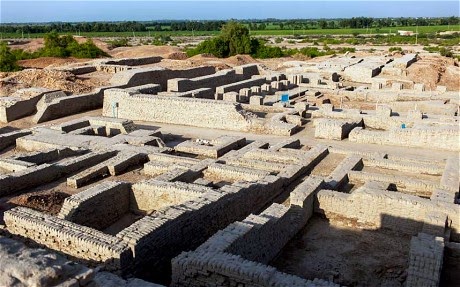
World’s only surviving Bronze Age Metropolis Faces Ruin in Pakistan


When archeologists first uncovered the 5,000-year-old ruins of Mohenjodaro, they made one of the greatest discoveries of the 20th century: the world’s only surviving Bronze Age metropolis. That was in colonial India in 1924. Today, the most important site of the Indus civilisation lies in Pakistan.  Now the once lost city is in danger of disappearing again as its clay wall houses, grid system roads, great granaries, baths and drainage systems crumble to dust, a victim of government neglect, public indifference and tourists’ fears of terrorism.  Archeologists have told The Sunday Telegraph that the world’s oldest planned urban landscape is being corroded by salt and could disappear within 20 years without an urgent rescue plan. Read more.
The Pakistani government is unable to look after the culture it has on its soil, yet - like all cultural property retentionist governments of the developing world - insists on retaining all of it hidden away in the deepest basements of their dusty museums rather than letting collectors preserve and display them. It is up to us to talk reason to these people and encourage them, by whatever means at our disposal, to adopt a more sensible and equitable cultural property policy, and we should make that a primary consideration in any future talks with Pakistan.

Thursday, October 10, 2013

US Museums Losing Fine Art to Blackmail


Museums say their mission to display global art treasures is under siege from underhand tactics by foreign governemts. A prime example is Turkey (Dan Bilefsky, 'Seeking Return of Art, Turkey Jolts Museums' NY Times Sept. 30, 2012). Turkey’s culture minister, Ertugrul Gunay is citing a 1906 Ottoman-era law — one that banned the export of artifacts — to claim any object removed after that date as "stolen Turkish property". In September 2011, the Museum of Fine Arts, Boston, returned the top half of an 1,800-year-old statue, “Weary Herakles,” which the Turkish prime minister, Recep Tayyip Erdogan, triumphantly took home on his government jet.

Museum of Fine Arts, Boston
The top half of the “Weary Herakles” statue recently taken from the Museum of Fine Arts, Boston by Turkey. Stuck in some dusty foreign museum basement, who will see it there?


Sunday, October 6, 2013

Cerámica de los Ancestros: Central America’s Past Revealed


Important exhibition: "Cerámica de los Ancestros: Central America’s Past Revealed", March 29, 2013–February 01, 2015 Washington, DC 


This bilingual (English/Spanish) exhibition illuminates Central America’s diverse and dynamic ancestral heritage with a selection of more than 160 objects. For thousands of years, Central America has been home to vibrant civilizations, each with unique, sophisticated ways of life, value systems, and arts. The ceramics these peoples left behind, combined with recent archaeological discoveries, help tell the stories of these dynamic cultures and their achievements. Cerámica de los Ancestros examines seven regions representing distinct Central American cultural areas that are today part of Belize, Guatemala, Honduras, El Salvador, Nicaragua, Costa Rica, and Panama. Spanning the period from 1000 BC to the present, the ceramics featured, selected from the museum’s collection of more than 12,000 pieces from the region, are augmented with significant examples of work in gold, jade, shell, and stone. 
The exhibition examines seven regions representing distinct Central American cultural areas that are today part of Belize, Costa Rica, El Salvador, Guatemala, Honduras, Nicaragua and Panama.